Jaro Varga
Old Cowboy or The Knight & the Czech King
2026
Jaro Varga in dialogue with Oldřich Haberle
site specific installation
drawing, mix media, textile bookmarks, video
@_isonative
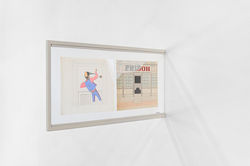
Over several months, I conducted a series of conversations with the animated filmmaker Oldřych Haberle about the past, politics, worldviews, and above all his work and memories. Beyond the animated films that shaped the visual imagination of my own childhood, Haberle moved confidently within worlds of knights, cowboys, and historical reenactments. Our dialogue was cut short by his death. His archive—an inexhaustible source of imagination, including a computer filled with unfinished projects and animated sequences—became the conceptual and visual core of the work “Old Cowboy or The Knight & the Czech King.”
The work engages this material through a time-based dialogue. Original drawings on tracing paper and phases of animated movement are reworked, interrupted, and overlaid with new images by me. This intervention is not a reconstruction of the archive, but a visual articulation of unspoken—and often conflicting—ideas; it responds to the differing political positions we shared during our meetings. Drawing thus becomes both a form of care and resistance, a gesture that builds on Audre Lorde’s reflections on care as a political act.
Several temporal layers intersect within the work: the time of Haberle’s drawings and stories; the time of reconstruction, in which I redraw the archive; the time of exhibition, where these layers meet before an audience; and finally the hermetic time of animation—the fraction of a second of phased movement that exists only as an illusion on paper. Between these temporalities, I can move freely, interrupt them, and reconnect them. The question remains whether—and how—it is possible to enter any of these times and, at least symbolically, alter the course and consequences of the stories.
Yet the stories never belonged to a single person. During our meetings, Haberle was constantly accompanied by his wife Lenka, who witnessed many of the memories. In the work, she appears as a voice that continues the narration where Oldřych’s voice ends.
 |  |
|---|---|
 |  |
 |  |
 |  |
 |  |
 |